

Scientific Illustration Process
Professional scientific illustration does not begin with a pencil or image software, but with a clear question: what scientific communication problem must we solve? Understanding how a rigorous image is constructed involves recognizing that the drawing is the visible phase of a much deeper process, where analysis and methodology are as vital as the visual technique employed.
Unlike other graphic disciplines, every decision here serves a specific purpose. Scale, perspective, the removal of secondary elements, or the choice of a particular format do not follow isolated aesthetic criteria, but rather the need to transmit knowledge with precision and coherence.
Scientific Illustration Purposes
Every professional scientific illustration is born with a defined purpose. It is not about representing reality exactly as observed, but about organizing it visually to make it comprehensible. The primary goal is to synthesize complex information without losing rigor.
In the academic sphere, the aim may be to enhance the clarity of a scientific paper or to synthesize the core of a study through a graphical abstract. In educational contexts, the goal may be to facilitate the assimilation and three-dimensional understanding of a biological system. In outreach, the purpose is usually to bring technical concepts to a non-specialized audience in an engaging and didactic way.
In all cases, professional scientific illustration acts as a strategic communication tool.
Workflow
The development of a professional scientific illustration follows a structured methodological sequence. This process is not rigid, but it is coherent and cumulative: each phase builds upon the previous one to guarantee scientific consistency and visual clarity.
Preliminary Planning
Work begins with a planning phase where the project scope, target audience, and publication context are defined. Producing a figure for a high-impact journal is not the same as developing teaching material or a museum piece. Each environment imposes specific technical standards, levels of detail, and formats.
During this stage, the timeframe is established and potential editorial or scientific constraints that may affect visual development are identified.
Content Analysis and Communication Goal Definition
Once the context is established, the scientific content to be represented is analyzed. This phase involves a deep understanding of the phenomenon, structure, or process in question. It is not merely about understanding it at a general level, but about interpreting it, identifying which aspects are essential for communication and comprehension, which may require simplification, and how to develop it without compromising accuracy.
Defining the communication goal allows for deciding whether the image should prioritize synthesis, structural detail, environmental context, or dynamic sequence. Based on this, the most appropriate visual format will be selected.
Scientific Documentation
Documentation is one of the foundations of rigor in professional scientific illustration. Specialized articles, anatomical atlases, fossil records, molecular models, or any relevant source that guarantees the accuracy of the representation are reviewed.
Conceptualization and Sketching
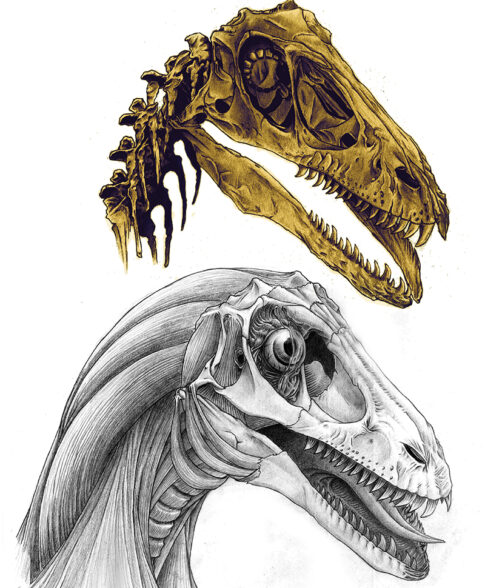
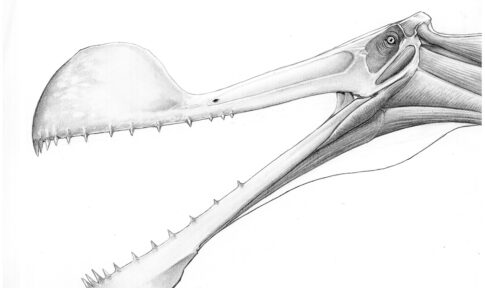
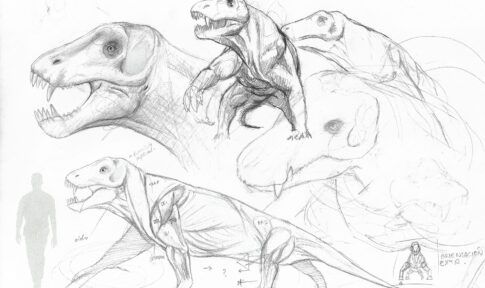
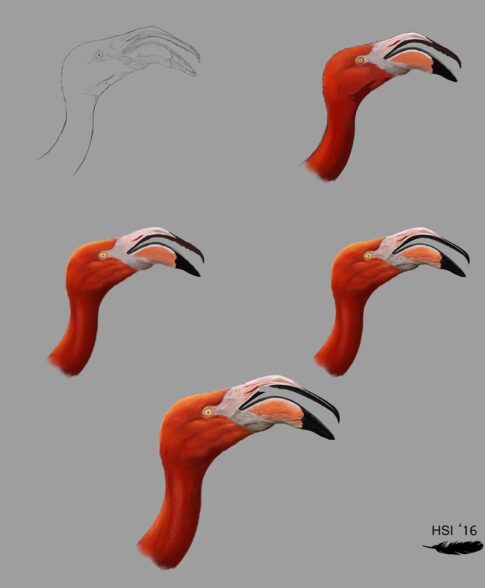
With the analyzed information, we proceed to visual conceptualization. At this stage, preliminary sketches are developed to organize and, ultimately, define visual strategies.
The sketch functions as a dialogue tool between the illustrator and the expert. It allows for the detection of potential inconsistencies before moving on to more advanced production phases and facilitates early adjustments to the structure of the image.
Technical Review and Validation
Before starting the detailed work, at least one technical review of the represented content is conducted. This expert validation is a defining element of professional scientific illustration. The specialist must evaluate the scientific accuracy of the conceptualized elements, morphological features, anatomical proportions, or process coherence, among others. In short, they must participate in the creative process, validating the image as scientifically sound.
This process may require several iterations. Far from being an aesthetic correction, it is a conceptual review.
If you are working on a research project and need to visualize these details with rigor, explore my graphic consultancy services.
Final Production
Once the structural base is validated, the final version of the illustration is developed. The choice of technique—whether 2D illustration, three-dimensional modeling, vector graphics, or a combination thereof—always responds to the project’s needs.
During this phase, morphological details, lighting, color, the integration of scientific labeling, and general visual coherence are addressed. The objective is to bring the prior conceptualization into detail, and it is primarily in this phase where the visual appeal of the piece is developed, always as a complement to its rigor.
Final Review and Validation
Before delivery, a final exhaustive review of content and form is conducted. It is verified that every detail added to the illustration has contributed positively to its accuracy, communicative effectiveness, and aesthetic appeal.
This final validation ensures that the professional scientific illustration can be seamlessly integrated into its final context.
Delivery
The delivery includes files optimized according to the distribution medium. In academic or editorial environments, specific formats, particular color profiles, or concrete resolutions are often required. In museum exhibitions or digital outreach, additional adaptations may be necessary.
The correct preparation of these files is an integral part of the professional process.
Co-creation and Expert Validation
One of the features that distinguish professional scientific illustration is its collaborative nature. The illustrator acts as a mediator between specialized knowledge and its visual representation. Expert validation is not a final formality, but a continuous process that accompanies the development of the project.
This co-creation ensures that the image is not only visually coherent but also conceptually accurate.
Visual Media and Techniques
Professional scientific illustration is not tied to a single medium or set of techniques. The choice of visual medium depends on the type of information to be represented and the application context.
In digital media, raster illustration or “digital painting” allows for meticulous control and modulation of form, volume, light, and color. It is especially suitable for realistic representations and for highlighting a richness of shapes, textures, and colors.
In contrast, vector illustration involves a simplification of form, volume, and color, but in return offers clarity and clean lines. It also allows for freedom from resolution constraints. It is, therefore, perfect for diagrammatic styles, graphs, and charts, as well as for developing iconography and signage in formats such as infographics.
Finally, three-dimensional modeling is ideal for complex structures that require volumetric understanding. It involves a greater commitment to the comprehension and 3D development of the represented elements, but in exchange, it offers the possibility of showing them from any perspective or viewpoint, contributing powerfully to their three-dimensional comprehension.
In many projects, a combination of techniques offers the most effective solution.
In all cases, the technique is subordinate to the scientific content.
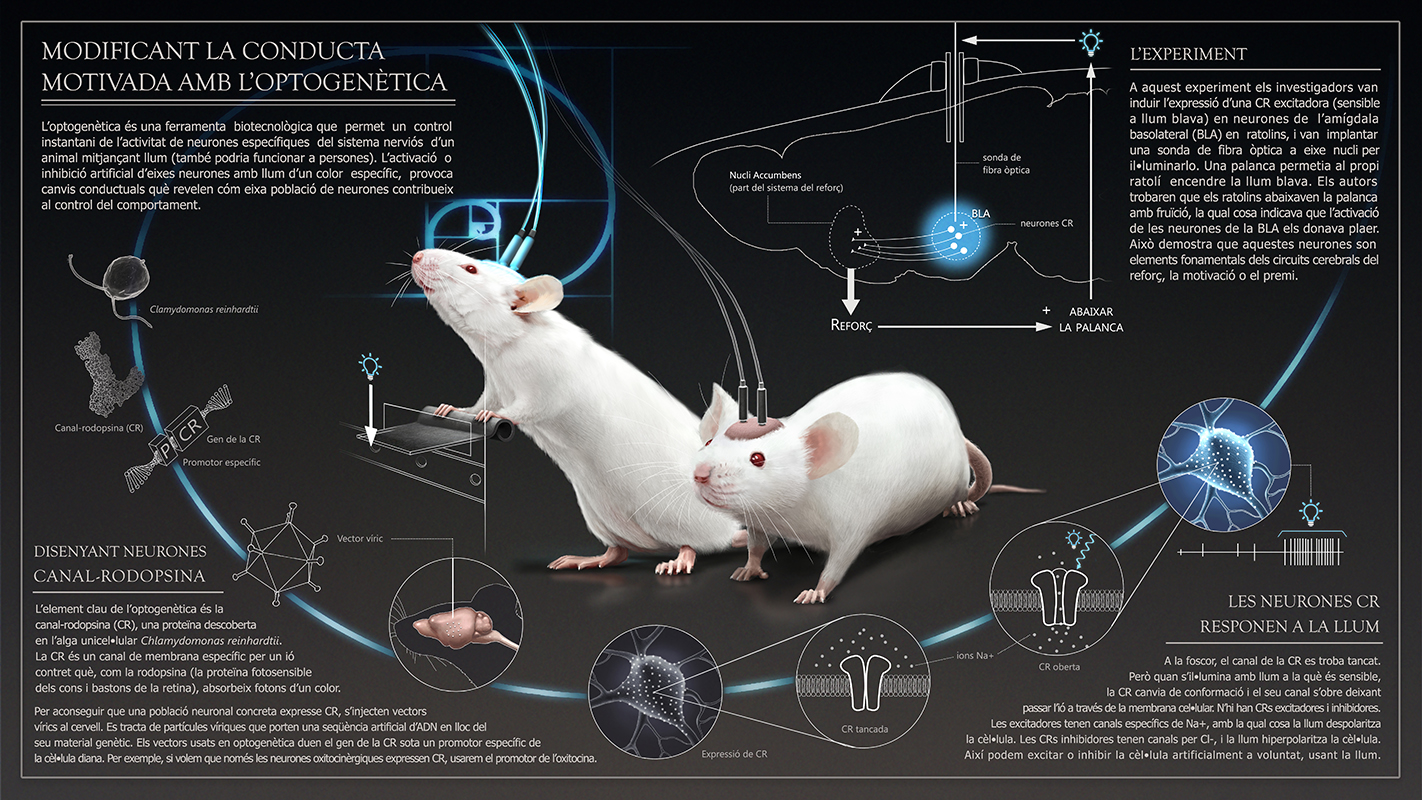
Visual Formats in Professional Scientific Illustration
Professional scientific illustration can take various formats depending on the application context and the communication goal. Each format serves a specific function within the academic, educational, or editorial ecosystem.
Scientific Figure
The figure is the most common format in academic publications. It is integrated into scientific articles, theses, or technical reports and aims to synthesize results, describe mechanisms, or represent structures, prioritizing clarity.
A professional scientific figure must be precise, legible at different scales, and coherent with the accompanying text. Its function is not decorative but structural: it facilitates immediate comprehension of the content.
Scientific Scene
The scene introduces context. Unlike an isolated figure, it represents an interaction, an environment, or a specific situation. It is common in paleontological, ecological, or educational illustration, where understanding spatial and environmental relationships is essential. In this format, principles such as composition, perspective, and visual hierarchy are key, along with more aesthetic elements like atmosphere, tone, movement, and dynamism.
Graphical Abstract
The graphical abstract is a strategic format within professional scientific illustration. Its function is to condense the conceptual core of a research project into a single, synthetic image.
In highly competitive academic environments, a clear and well-structured graphical abstract can make the difference in an article’s visibility. It requires extreme synthesis skills and a deep understanding of the study.
Increase your article’s citations with a professional Graphical Abstract. Request information.
Scientific Infographics
Scientific infographics combine imagery, signage, and structured text. They are frequently used in outreach, education, and institutional communication. Their strength lies in condensing a large amount and variety of information, employing all types of resources and visual strategies to convey it in an integrated, accessible, and attractive way without losing rigor.
In this format, communicative clarity and hierarchy are decisive. The design must guide the reader in a logical and progressive manner.
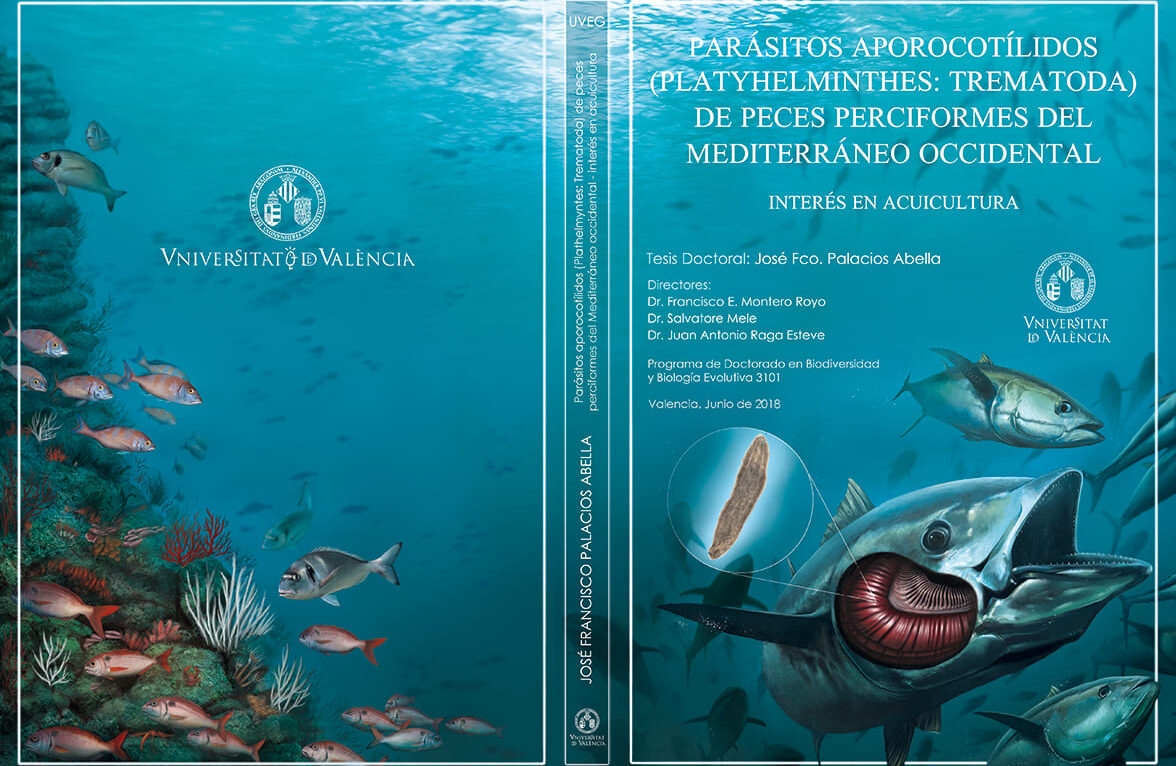
Scientific Journal Cover
The cover of a scientific journal or publication requires a delicate balance between visual impact and conceptual accuracy. It is not about creating a striking image detached from the content, but about representing the core of the work in a visually powerful and original way.
In this format, visual appeal takes center stage. It is a medium that allows for a departure from literal interpretation, enabling the exploration of a more metaphorical or symbolic register.

Other Specialized Formats
Professional scientific illustration can also be adapted to many other specific formats (museum panels, teaching materials, or interactive visualizations, to name a few examples). In all cases, the principle remains the same: the visual form adapts to the specific communicative need.
Project Timelines and Management
Time management is a fundamental aspect, especially when the illustration is part of a scientific publication or a competitive call. Establishing clear phases, with defined moments for review and validation, allows for maintaining control over the process without compromising technical quality.
Professional scientific illustration requires time for analysis, development, and review. Proper planning avoids improvisations that could jeopardize the rigor of the final result.
Final Delivery and Formats
The final phase of the process consists of preparing the illustration for its definitive integration. This involves ensuring that the files meet the technical requirements demanded by publishers, institutions, or digital platforms.
Resolution, color profiles, correct font embedding, and format compatibility are technical aspects that are part of the professional standard. A scientifically flawless illustration must also be technically reproducible.
Frequently Asked Questions
How long does it take to create a professional scientific illustration?
The development time depends on the complexity of the content, the level of detail required, and the number of necessary review phases. A professional scientific illustration is not limited to visual execution: it includes analysis, documentation, technical review, and final file preparation. These additional steps are essential to guarantee rigor and consistency.
What is the best format for a scientific publication?
It depends on the objective of the article. A technical figure is suitable for describing specific results, while a graphical abstract allows for synthesizing the conceptual core of the study. In some cases, a scientific infographic can facilitate the understanding of complex processes. The choice of format is part of the project’s communicative strategy.
What is the difference between a professional scientific illustration and a conventional illustration?
The main difference lies in the methodology and the level of validation. Professional scientific illustration starts with specialized documentation, requires expert review, and responds to a precise scientific communication goal. It is not merely about designing an attractive image, but about representing verifiable information with conceptual accuracy.
What files are delivered with a professional scientific illustration?
The delivery includes files optimized according to the technical requirements of the publication medium. Academic environments typically require specific resolutions, determined color profiles, and formats compatible with editorial systems. Proper technical preparation is an integral part of the professional standard and guarantees the reproducibility of the image.
Is expert validation necessary for a scientific illustration?
Yes. Expert validation is one of the elements that define professional scientific illustration. It allows for the verification of proportions, structural relationships, and consistency with current scientific knowledge. This process reduces errors and ensures that the image is a reliable communication tool.
Take your scientific publication to the next level with high-impact imagery. Contact me for a personalized quote.